
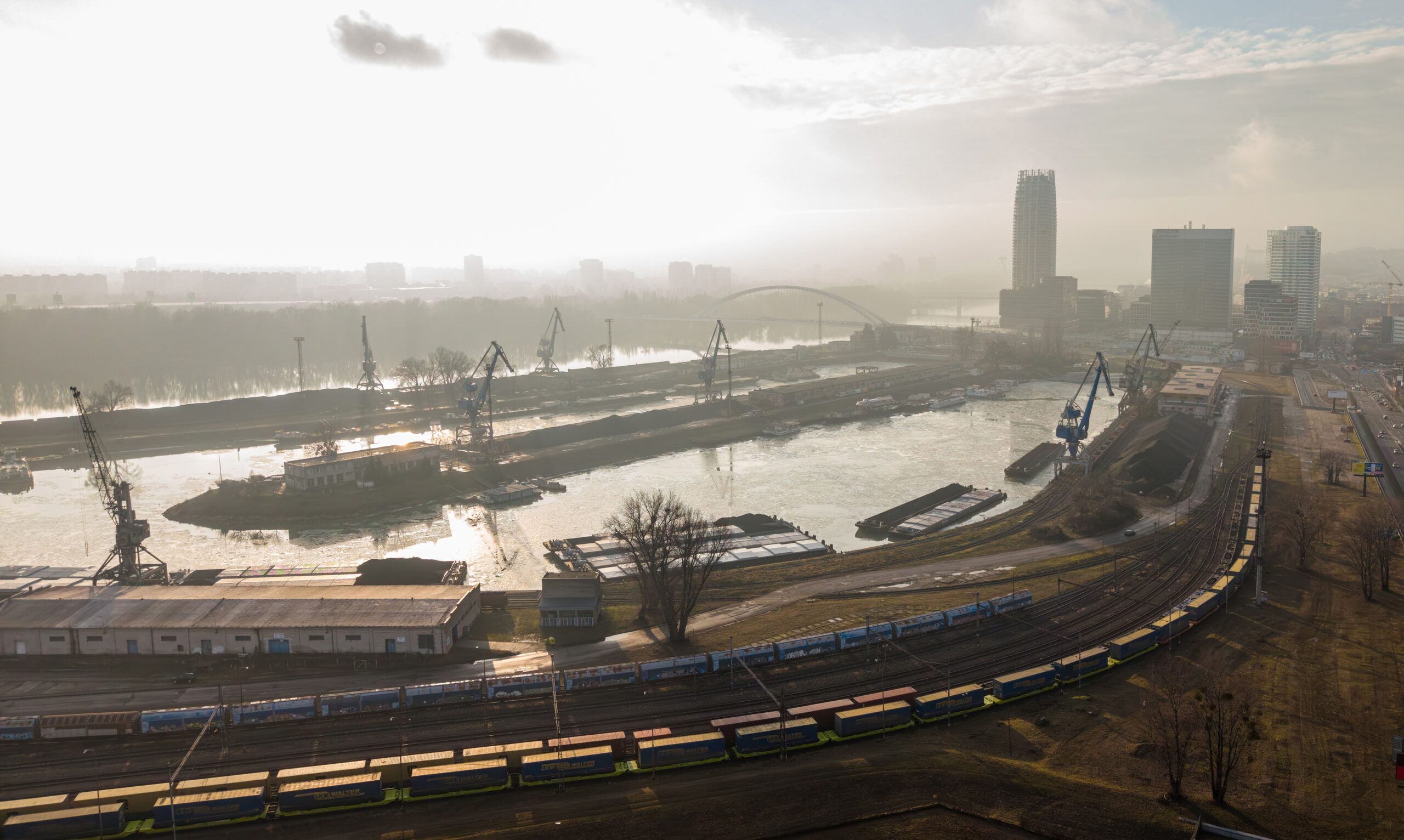
The majority owner, Public Ports (Verejné prístavy, a. s.), and the City of Bratislava, are launching an international two-stage masterplanning competition for the transformation of the Winter Harbour in Bratislava, one of the last major waterfront regeneration sites in direct contact with the expanding city centre of the Slovak capital.
The competition is organised by the Metropolitan Institute of Bratislava. First-stage submissions are due till end of May 2026. The expert jury consists of internationally respected architects with experience of waterfront transformations across European cities.
Exceptional yet undiscovered potential
With an area of approximately 65 hectares, including historic harbour basins and extensive waterfronts, the Winter Harbour is one of the last redevelopment opportunities in direct contact with the expanding city centre and the Danube River. Its transformation will play a decisive role in redefining Bratislava as a city on the river.
“The competition presents a unique opportunity to reconnect Bratislava with its waterfront and to redefine the relationship between city center, the river and the natural environment,” said Paco Bunnik, jury member and Chief Urban Designer of the City of Amsterdam.
Catherine Burd, British architect and the jury co-chair underlined, that “the redevelopment of this dockland site in Bratislava is a chance to create a people-centred, ecological urban quarter for the young, outward-looking and rapidly expanding capital city. This ambitious competition encourages teams to reimagine what is perhaps the last undeveloped industrial dockland site in a European capital, and to play a key part in shaping the city’s future”.
The design brief calls for multidisciplinary teams with expertise in masterplanning, urban design, heritage, landscape and placemaking, supported by technical, environmental and economic insight, to respond to the site’s unique spatial, cultural and natural conditions. While inspiration may be drawn from successful European harbour transformations, proposals must be rooted in Bratislava’s specific character, history and landscape.
“The aim is not to replicate existing models, but to create a distinctive urban district authentic to the Winter Harbour and unmistakably rooted in its context,” explains Petra Marko, CEO of the Metropolitan Institute of Bratislava.
The outcome of the competition will define the long-term framework for the development of a new district on the Danube for and serve as a basis for subsequent architectural competitions. The ambition is to create a district of metropolitan significance that combines everyday urban life with high-quality, people-oriented public spaces and a renewed relationship between the city and the river.
From closed port to open waterfront
Today, the Winter Harbour operates as a largely inaccessible logistics transhipment area, forming one of the last barriers between the city centre and the Danube.
“We believe the right urban solution can open this area to people, introduce new functions and high-quality public spaces, while respecting the Harbour’s history. It should naturally coexist with the operational river port in the Pálenisko zone, which we intend to preserve and further modernise in this location. Our ambition is not to create just another urban district, but a vibrant heart of Bratislava on the Danube — with places for meeting, working and relaxing, for both residents and visitors,” noted Matej Danóci, CEO of Public Ports (Verejné prístavy, a.s.)
The Winter Harbour offers an opportunity to create a compact neighbourhood with a continuous riverside promenade along the Danube, attractive public spaces, a marina, accessible piers and even urban bathing facilities inspired, for example, by Copenhagen.
Public spaces and access to water will define the future Winter Harbour. Proposals are expected to plan for urban density that supports a vibrant, mixed-use environment based on the 15-minute city principles. “Streets, squares, parks, promenades, industrial heritage and the waterfronts will form the main framework defining the urban form, movement, identity and social life of the area,” adds Peter Gero, expert advisor of the development vision, jury member and co-creator of Hamburg’s HafenCity district.
“Green infrastructure is a backbone of each development and supports good microclimate. Avoiding future urban Heat islands is a central challenge. Quite unique is the high potential of blue infrastructure that the Winter Harbour offers with its two basins.” added jury member Eva Kail, who has spearheaded inclusive regeneration in Vienna.
The transformation of the Winter Harbour is about shaping the future identity of Bratislava as a city that lives with its river, values its heritage and prioritizes high-quality public space as a foundation of urban life.