
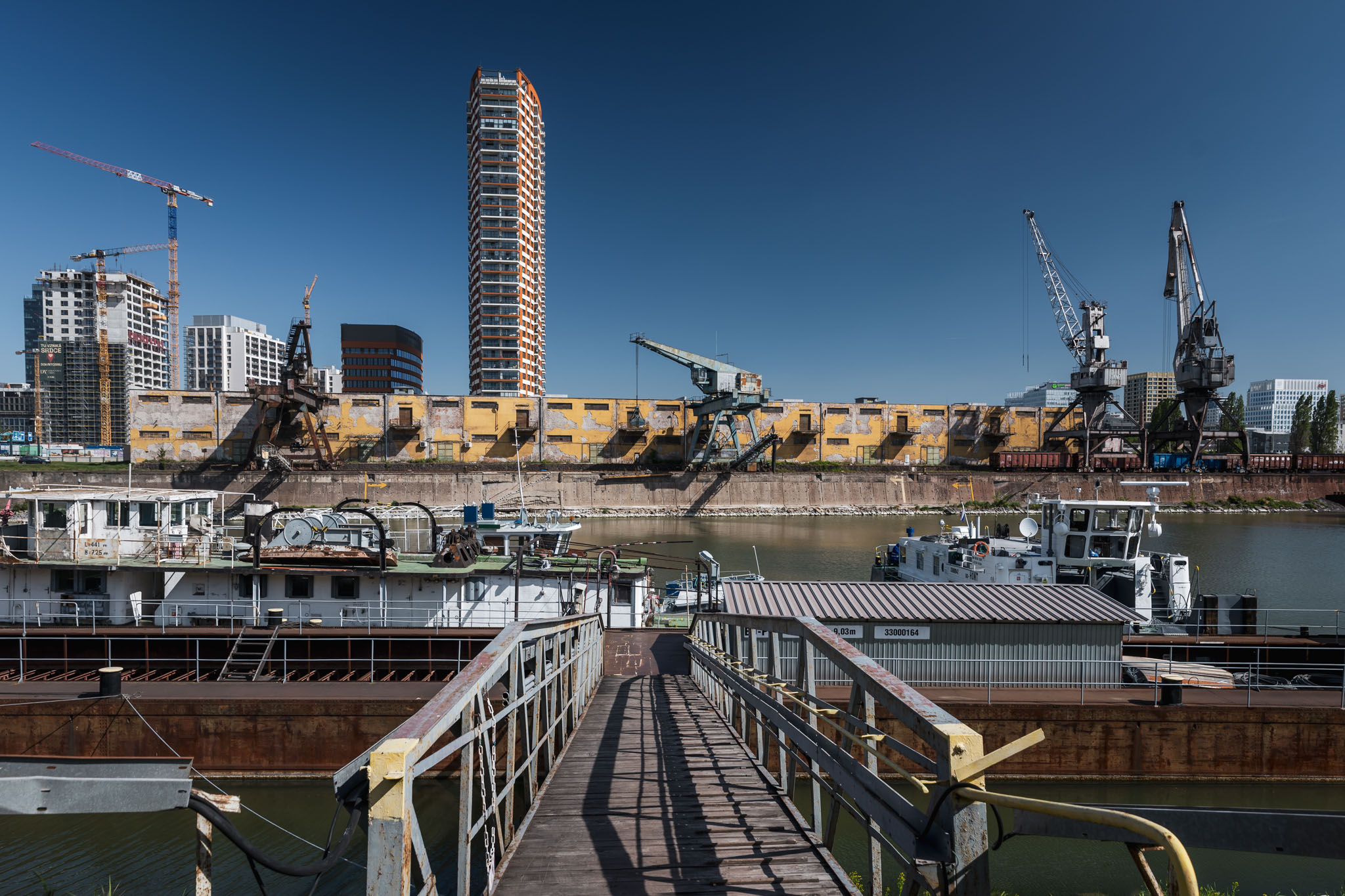
Out of 123 proposals submitted by teams from 33 countries, the international jury selected seven proposals to advance to the next stage. The shortlisted teams will now further develop their designs, incorporating both the jury’s recommendations and the outcomes of the public participation process.
The competition is organised by the Metropolitan Institute of Bratislava, together with Public Ports a.s. and the City of Bratislava. Its aim is to identify a strong urban vision for one of the most important transformation areas in the Slovak capital — a 65-hectare port site on the Danube, currently inaccessible to the public, with major potential to become a new, open and mixed-use urban district.
Winter Harbour is considered one of the last compact transformation areas in Bratislava’s wider city centre. Its future development raises complex questions related not only to urban planning, but also to flood protection, access to water, industrial heritage, landscape, public space and long-term sustainability.
According to the jury, the exceptional number of submissions confirms the international significance of the site and the strong interest of the professional community in contributing to its transformation.
“The interest in the international competition goes beyond Bratislava and the Slovak Republic. I myself have never experienced such a number of proposals in a competition as a juror. This scale gives us a real chance to select a truly fantastic proposal for Bratislava,” said Michal Sedláček, chair of the jury, Czech architect and former chief architect of Brno. “What interested me was the relationship between the port, the water and the buildings, which is truly exceptional — most inland cities do not have a port.”
The quality of public space and the relationship between the new district, the city and the river were among the key aspects assessed by the jury.
“123 is a huge number, but at the same time it is possible to recognise relatively quickly which proposals have real potential and can work,” said Catherine Burd, vice-chair of the jury and British architect specialising in strategic planning, heritage and high-quality public spaces. “In my view, these are mainly proposals that offer a very good hierarchy of public space — thoughtful planning that considers how to connect this new district to the rest of the city and how to communicate with the water.”
For Peter Gero, Slovak architect and urban planner based in Germany, co-author of HafenCity in Hamburg and guarantor of the Winter Harbour development vision, the strong participation in the competition is also a sign of Bratislava’s wider relevance.
“The high level of participation in the competition confirms to me that even the wider world recognises the importance of Bratislava, as well as its economic and natural potential, which local people may not always fully realise,” said Peter Gero. “When evaluating the proposals, I focus above all on the quality of public spaces and the connection between urbanism and the river.”
The jury also emphasised the importance of openness, adaptability and the civic character of the future district.
“The quality of the proposals is generally very high. Some are quite radical, while others are more moderate and well designed,” said Paco Bunnik, Dutch architect and chief urban planner of Amsterdam. “For me, it is extremely important that the space can adapt to cultural and civic programmes and create a democratic space that the city of Bratislava can discover. Perhaps the aim is not to find a plan that already feels complete, but rather one that contains an idea that can be developed further in the next stage.”
Locals care for future of Winter Harbour
At the same time, the competition is not based solely on expert assessment. As part of the process, the Metropolitan Institute of Bratislava also led a broad public participation process to understand how Bratislava residents imagine the future of Winter Harbour.
Nearly 800 Bratislava residents took part in the participation process. In April and May, they were able to share their views during guided walks through the otherwise closed port area, in person through focus groups at TU-BA, or via an online questionnaire. The public agreed that they imagine Winter Harbour as a lively, recreational, green, accessible and authentic district with high-quality public spaces for everyone.
Among the most frequently discussed topics were better access to the water and its use, preservation of the area’s industrial character, more greenery and shade, safe movement on foot and by bicycle, a representative cultural venue, opportunities for water sports and other less traditional sports, friendly community spaces, and accessible services for future residents and visitors.
Some residents would like to see Winter Harbour become the centre of a true metropolis, with representative public spaces and high-rise buildings. Others would prefer this section of the riverfront to retain a wilder character, with lower-rise development. At the same time, the public expressed concerns that the area could become too elitist, commercial or closed-off, with monotonous or overly dominant architecture.
The participation report summarises the needs, expectations and concerns of Bratislava residents. Its purpose is to ensure that the final proposals in the current round of the competition respond not only to expert and technical requirements, but also to the ideas of the people who will use the future public spaces.
“Bratislava residents are actively interested in the future of Winter Harbour, which is also evident in the strong public interest in taking part in the competition’s participation process. We would like to thank everyone who contributed their views to the discussion about the future of this part of the city,” said Petra Marko, Director of the Metropolitan Institute of Bratislava.
The transformation of Winter Harbour is expected to be a long-term process. The current competition is a key step towards defining the future character of the area. The winning proposal will be announced in November 2026.