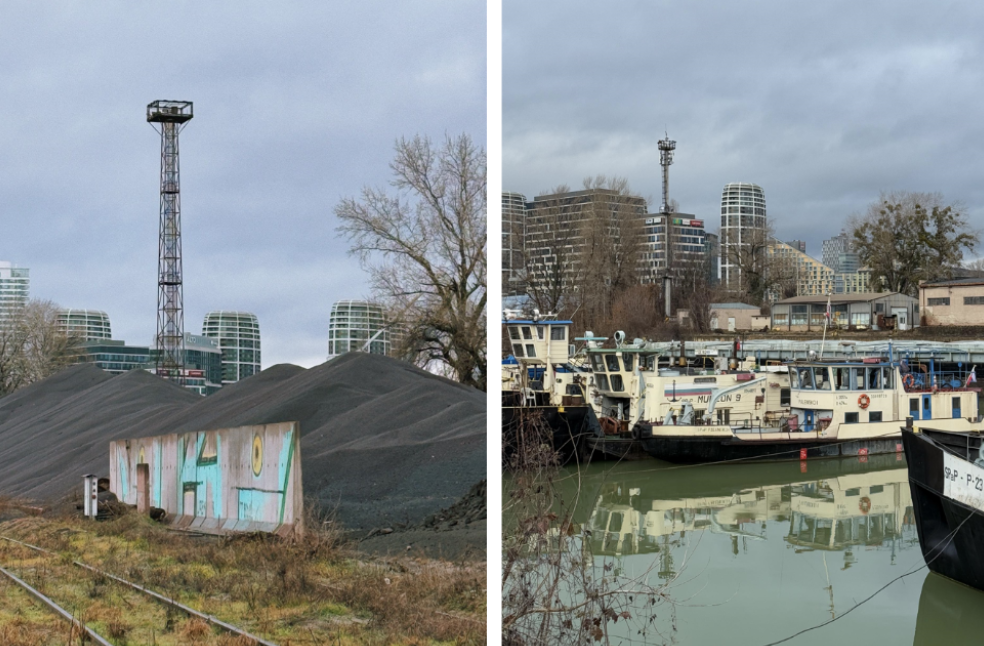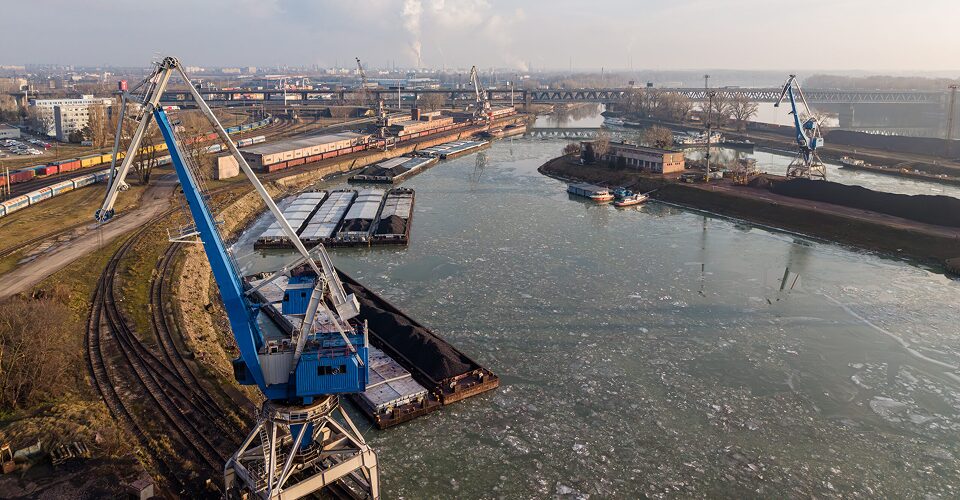
The Metropolitan Institute of Bratislava has prepared a vision for its transformation, commissioned by the site owner, the state-owned company Public Port (Verejné prístavy, a. s.)
The final document is the result of coordination with experts, stakeholders, the City of Bratislava, and international specialists. The vision defines the framework for how this exceptional location should evolve in the future and at the same time opens the way for an international design competition.
The Winter Harbour is a historically significant industrial area of Bratislava, covering approximately 65 hectares, with several protected heritage structures. It currently operates as a cargo harbour on the Danube and is located in close proximity to the rapidly developing Mlynské nivy district.
Significance of the area
The Bratislava Winter Harbour was in its time among the largest ports on the Danube in the Kingdom of Hungary and was established as a result of the river regulation of the Danube between 1886 and 1896.
The construction of the port in 1897 was linked to the development of the industrial district and the railway infrastructure, which is still present there today.
The character of the Harbour changed during and between the world wars and the transport began to decline after 1989, when river transport was largely replaced by road and rail freight.
In recent years, however, its capacity has not been fully utilised. Today, the port operates at approximately 25% of its capacity and awaits its renewal. For this reason, the state — represented by the Ministry of Transport of the Slovak Republic and the Public Port — has taken a strategic decision regarding the future development of this area. “The concentration of transshipment capacities in the ,Pálenisko´ area was a strategic decision by the state aimed at more efficient harbour operations and freeing up the Winter Harbour for new urban development. This step creates the conditions for transforming a currently closed area into a fully functional and accessible part of Bratislava. We see the vision as an important professional framework for further decision-making about the future of this site,” says Matej Danóci, CEO of Public Port.
The Chief City Architect of Bratislava, Juraj Šujan, highlights the importance of the area: “The Winter Harbour is a unique location close to the city centre that should become an integrated and accessible part of it — a district with high-quality infrastructure and a direct relationship to the river.”
Every project starts with an idea
The first step towards this transformation is the Vision for the Development of the Winter Harbour Area. The document was developed over more than a year in cooperation with experts, public institutions and international specialists. Its aim was to verify the urban, technical, economic and environmental feasibility of the transformation, including flood protection measures and the preservation of heritage assets. “During the preparation of the vision, we carried out surveys and analyses and developed an initial concept, which was subsequently consulted with key stakeholders and experts. After collecting feedback, this concept was refined into its final form,” explains Daniel Tomko, urban planner of the Metropolitan Institute of Bratislava.
Based on the client’s request, the resulting comprehensive document will also serve as a basis for preparing Amendments to the City’s Land Use Plan, given that the project represents a strategic state investment. “The vision defines the framework for what a vibrant part of the city in the Winter Harbour should look like. The task is to establish principles for future development—creating an open and accessible waterfront district with high-quality public spaces, greenery, and respect for the site’s industrial history. Examples from the transformation of other European harbours show that long-term professional consensus on these principles is crucial,” explains the vision’s expert guarantor, architect Peter Gero, a co-author of a comparable district in Hamburg.
International competition as the next step
The vision will be directly followed by an international, two-stage masterplanning competition, the outcome of which will be a comprehensive masterplan for the area.
The masterplan will define the spatial structure, the distribution of functions and building volumes, and the concept of public spaces, including transport infrastructure and flood protection.
The competition will be organised by the Metropolitan Institute of Bratislava and announced jointly by Public Port and the City of Bratislava. The organiser also intends to include public participation in the competition process, particularly in relation to public spaces.
The competition itself will not mark the end of the process—after both rounds are evaluated, the masterplan will be further refined based on feedback and elaborated through smaller-scale projects.
Inspiration from European waterfront cities
In preparing the vision, Bratislava studied examples of European cities that have successfully transformed former harbour and industrial areas—such as Hamburg (HafenCity), Amsterdam, Malmö, and Copenhagen (Nordhavn). Representatives of the Metropolitan Institute of Bratislava, the city, and the harbour authorities visited these cities or consulted with their representatives. Architects from Amsterdam and Malmö also visited Bratislava and its harbour.
The shared lessons from these examples show that successful transformations are characterised by a long-term process, strong public regulation, a focus on public spaces and cultural functions, and the preservation of local identity.
There are few national cultural monuments, including the Seamen’s House (1940), the Art Nouveau pumping station building (1904), the oldest preserved vessel in Slovakia—the tugboat Šturec (1937), the ship lift (1940), and the two oldest cranes. Other valuable structures include warehouses, the ship repair workshop, the harbour basins themselves, and remnants of the railway infrastructure. “The Winter Harbour is not an ordinary brownfield. It is a place with a unique history, a strong relationship to the Danube, and significant technical heritage structures. These qualities should become the foundation of the new district, not an obstacle to its development,” underlines Petra Marko, CEO of the Metropolitan Institute of Bratislava.
A long-term process aiming for public consensus
Representatives of the city and the harbour emphasise that the transformation of the Winter Harbour is a long-term, phased process that requires time, expert preparation and coordination between the public and private sectors.
The first step is reaching an agreement on what kind of urban district should emerge in the area. The ambition is to create a modern, mixed-use, accessible and climate-resilient district with high-quality public spaces—one that naturally extends Bratislava’s city centre, opens the Danube riverbank to the public, and preserves the unique industrial genius loci of the Winter Harbour and its heritage structures for future generations.
Information about the launch date of the competition will be announced at the end of February.
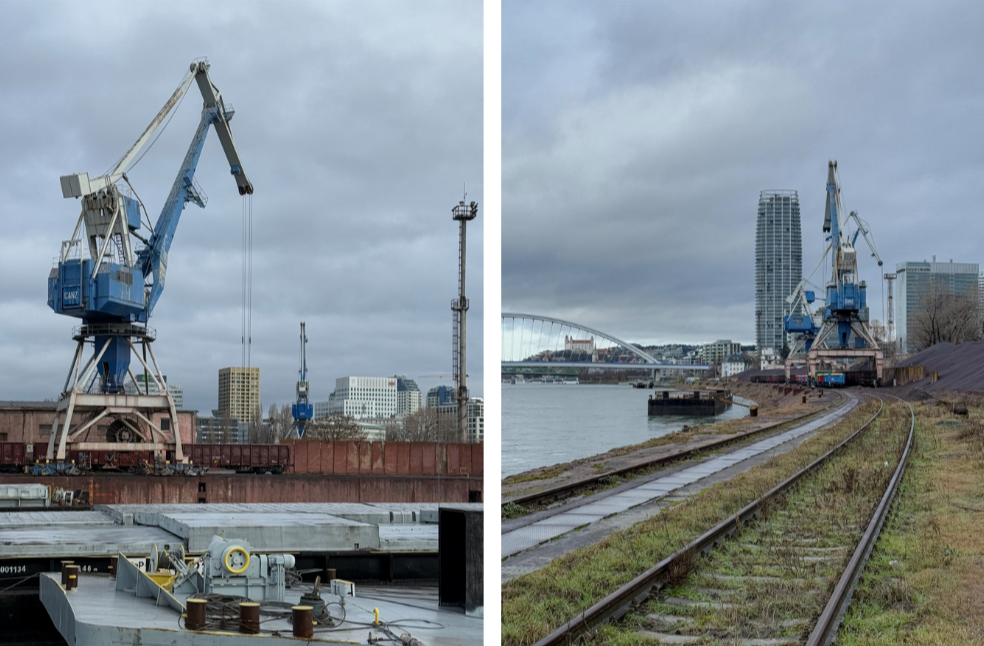
Cranes as the most dominant elements of the Winter Harbour, with new redevelopments in the Mlynské Nivy area and the Eurovea Tower, alongside Bratislava Castle, in the background
After the First World War, the Harbour began to be transformed into a modern cargo river port, enabling Bratislava to assume a more significant role in international trade. This period also saw the establishment of the “Oriental Market,” held annually from 1923 to 1942, aimed at strengthening Bratislava’s position in international markets and fostering both international and local trade relations.
During the Second World War, the Harbour became a target of Allied bombing raids, which caused severe damage. Air attacks took place on 16 June 1944, 20 September 1944, and 7 and 21 February 1945, affecting not only the harbour but also the Apollo refinery.
After the war, extensive reconstruction works began, and from 1948 onwards the Winter Harbour once again became an important transhipment hub for materials and goods. During the socialist period, it was integrated into the centralised economic system and served primarily for the transport of industrial raw materials and goods within the Eastern Bloc.
Between 1975 and 1983, the Pálenisko Harbour and the so-called Shipyard (ship repair facility) were gradually constructed. Pálenisko was a more modern Harbour and, like the Winter Harbour, served cargo transhipment purposes, including new facilities for mineral oil handling. The shipyard was dedicated to vessel repairs (Figure 2).
After 1989, river transport on the Danube lost much of its original importance, with part of freight transport shifting to road and rail. Nevertheless, the Winter Harbour retained its historical value, and several structures within the area, as well as the harbour, were designated as national cultural monuments (Bartošíková, 2018).
The Art Nouveau pumping station building (1904), the Seamen’s House (1940), the ship lift (1940), the ship repair workshop (1943), the harbour warehouse (1928), warehouses No. 7 (1921) and No. 17 (1928), the oldest preserved vessel in Slovakia – the tugboat Šturec (1937) – and the two oldest cranes dating from the 1970s are designated as National Cultural Monuments. The harbour, including its basins, is also listed as a National Cultural Monument.
The area also contains other collection items and movable heritage objects, such as the rare tugboat Zvolen, part of the collection of the Technical Museum, as well as a substantial amount of technical infrastructure that contributes to the harbour’s historic and technical character, including railway tracks, boarding gangways and ship mooring elements.
The Winter Harbour still serves its original purpose as a cargo transshipment area, although to a much more limited extent than originally envisaged.
Today, the Winter Harbour still serves its original function as a cargo transhipment area, albeit to a much more limited extent than originally envisaged.
The Harbour area thus represents a unique combination of the city’s memory, its original and still active role as a cargo transhipment facility, and its future potential.