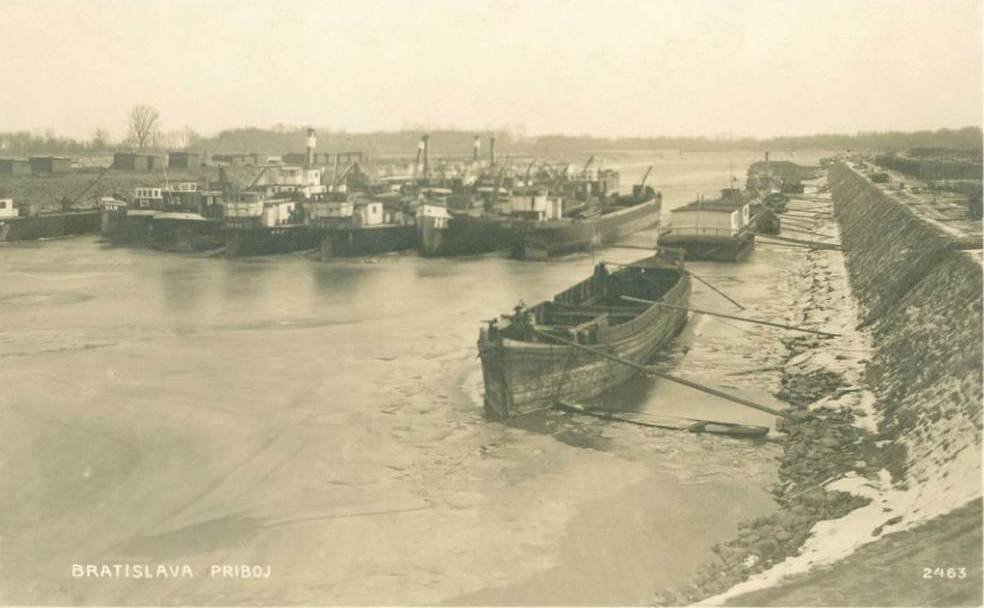
Cover photo: Ships in the Winter Harbour, 1922, Source: Bratislavské rožky, J. Horváth Collection, www.pamiatky.sk
The construction of the Winter Harbour in Bratislava represents a significant milestone in the history of Danube river navigation and the city’s urban redevelopment.
Its establishment is closely linked to extensive river regulation works carried out between 1886 and 1896, which rank among the most fundamental interventions in Bratislava’s landscape. The regulation of the Danube into a single, stable navigation corridor with a width of 300 metres aimed to simplify navigation and enable more efficient river transport. The regulation covered 80 kilometres of the riverbed, with relatively steep banks reinforced with quarried stone.
In 1897, construction of the Winter Harbour began between the new course of the Danube and the Brenner branch. Originally, the site was intended for a smaller Harbour serving passenger vessels and wintering ships; however, the final decision was to build a Harbour with a capacity for 200 vessels. This represented a major step for Bratislava, as it became one of the largest ports on the Danube within the Kingdom of Hungary at the time.
The construction of the Harbour was closely connected to the redevelopment of the industrial district and the railway network, the construction of which began with the infilling of the Čalovské branch in 1892. The creation of the arbour required the relocation of approximately 1,300,000 cubic metres of earth. Works included the formation of an elevated plateau, terrain modifications, the construction of flood protection embankments, and a system of siding tracks to service the harbour. Over time, additional smaller structures such as warehouses and customs facilities were added, and from 1916 onwards the riverbanks were adapted with the installation of DDSG cranes (Figure 1), which accelerated unloading operations and reduced vessel turnaround times.
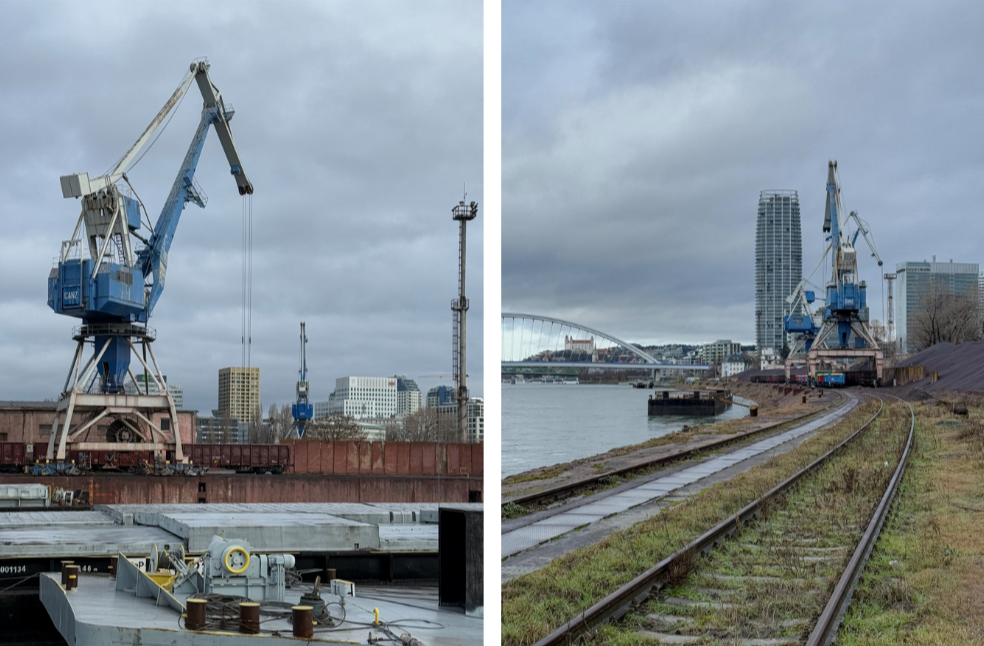
Cranes as the most dominant elements of the Winter Harbour, with new redevelopments in the Mlynské Nivy area and the Eurovea Tower, alongside Bratislava Castle, in the background
After the First World War, the Harbour began to be transformed into a modern cargo river port, enabling Bratislava to assume a more significant role in international trade. This period also saw the establishment of the “Oriental Market,” held annually from 1923 to 1942, aimed at strengthening Bratislava’s position in international markets and fostering both international and local trade relations.
During the Second World War, the Harbour became a target of Allied bombing raids, which caused severe damage. Air attacks took place on 16 June 1944, 20 September 1944, and 7 and 21 February 1945, affecting not only the harbour but also the Apollo refinery.
After the war, extensive reconstruction works began, and from 1948 onwards the Winter Harbour once again became an important transhipment hub for materials and goods. During the socialist period, it was integrated into the centralised economic system and served primarily for the transport of industrial raw materials and goods within the Eastern Bloc.
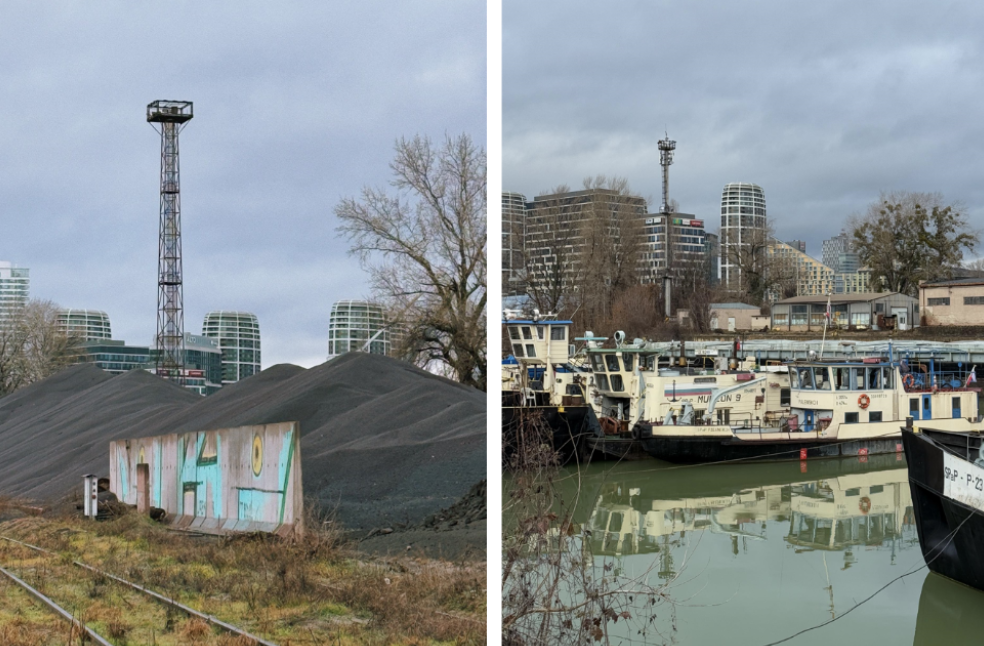
Between 1975 and 1983, the Pálenisko Harbour and the so-called Shipyard (ship repair facility) were gradually constructed. Pálenisko was a more modern Harbour and, like the Winter Harbour, served cargo transhipment purposes, including new facilities for mineral oil handling. The shipyard was dedicated to vessel repairs (Figure 2).
After 1989, river transport on the Danube lost much of its original importance, with part of freight transport shifting to road and rail. Nevertheless, the Winter Harbour retained its historical value, and several structures within the area, as well as the harbour, were designated as national cultural monuments (Bartošíková, 2018).
The Art Nouveau pumping station building (1904), the Seamen’s House (1940), the ship lift (1940), the ship repair workshop (1943), the harbour warehouse (1928), warehouses No. 7 (1921) and No. 17 (1928), the oldest preserved vessel in Slovakia – the tugboat Šturec (1937) – and the two oldest cranes dating from the 1970s are designated as National Cultural Monuments. The harbour, including its basins, is also listed as a National Cultural Monument.
The area also contains other collection items and movable heritage objects, such as the rare tugboat Zvolen, part of the collection of the Technical Museum, as well as a substantial amount of technical infrastructure that contributes to the harbour’s historic and technical character, including railway tracks, boarding gangways and ship mooring elements.
The Winter Harbour still serves its original purpose as a cargo transshipment area, although to a much more limited extent than originally envisaged.
Today, the Winter Harbour still serves its original function as a cargo transhipment area, albeit to a much more limited extent than originally envisaged.
The Harbour area thus represents a unique combination of the city’s memory, its original and still active role as a cargo transhipment facility, and its future potential.